AI-based contact center are transforming customer support through AI, reshaping how businesses support, retain, and delight customers. Instead of relying solely on human agents and manual processes, modern contact centers now leverage artificial intelligence voice bots (인공지능 음성봇) that can listen, understand, route, and even resolve customer issues in real time. The result is faster service, lower costs, and more satisfied customers and employees alike.
Modern contact centers rely on intelligent cloud solutions to scale efficiently while analyzing vast amounts of customer data. By combining cloud infrastructure with AI-driven analytics, businesses can gain real-time insights, optimize call routing, predict customer needs, and automate follow-ups—ensuring every interaction is relevant and efficient without overburdening human agents.
These capabilities are powered by next-generation computing innovations, enabling sophisticated algorithms for voice recognition, sentiment analysis, and context-aware responses. This technology allows systems to understand natural language, detect emotions, and provide personalized solutions, creating seamless experiences that feel human yet operate at AI speed.
Customer engagement is further enhanced through marketing automation with the help of AI, which uses AI to analyze behaviors and preferences, deliver personalized messaging, recommend services or products, and trigger proactive support interactions. Aligning these insights with customer support helps businesses increase loyalty and satisfaction while reducing manual effort.
Predictive marketing intelligence takes this one step further, allowing AI systems to anticipate customer needs and optimize outreach strategies. By detecting behavior patterns, AI can recommend tailored offers and automate follow-ups, ensuring that marketing and support work together to maximize customer retention and growth.
Operational efficiency is also improved with intelligent finance automation, which automates billing, optimizes workforce allocation, and forecasts operational costs. This frees human agents to focus on providing superior customer experiences while ensuring the business operates efficiently and sustainably.
By combining cloud-based infrastructure, advanced computing, predictive marketing, and automated financial insights, modern contact centers are delivering faster, smarter, and more personalized customer service, creating loyal customers and empowered employees alike.
What Is an AI-Based Call Center?
AnAI-based call centeris a customer service operation that uses artificial intelligence to automate and enhance call handling and digital interactions. AI does not simply replace humans; it augments human agents with powerful tools that can analyze conversations, guide responses, and handle routine tasks end-to-end.
Instead of the traditional model where every interaction depends on manual work, AI-based call centers use technologies likenatural language processing,machine learning, andspeech analyticsto understand customer needs and respond in a smart, scalable way.
Top AI-Based Call Center Solutions to Improve Customer Experience and Boost Agent Efficiency
Artificial intelligence is transforming the way call centers operate. From intelligent routing to predictive analytics, AI-powered solutions help businesses deliver faster, more personalized, and efficient customer support. Below is a list of leading AI-based call center platforms:
- Bright Pattern
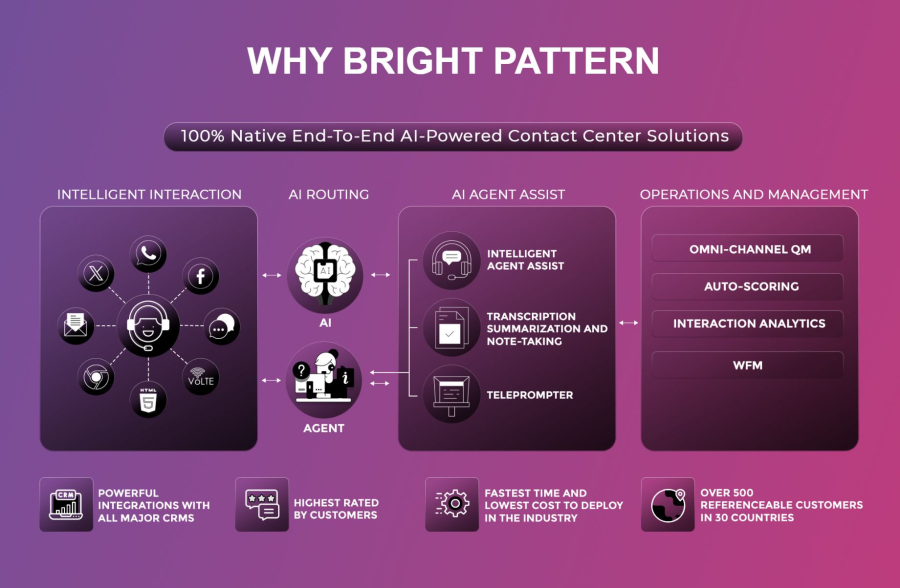
Bright Pattern is a leading AI-powered contact center solution designed to enhance customer engagement across multiple channels. It provides omnichannel support, including voice, chat, email, SMS, social media, and video, allowing agents to interact seamlessly with customers wherever they are. Its AI capabilities include intelligent call routing, predictive analytics, automated workflows, and real-time agent assistance, enabling agents to respond faster and more accurately. Bright Pattern also offers advanced self-service automation with AI chatbots, helping reduce call volume and operational costs while improving customer satisfaction. Businesses can monitor performance in real-time, gain actionable insights from AI-driven reporting, and scale operations efficiently without compromising quality. The platform is highly customizable, making it suitable for organizations of all sizes across industries.
- Five9
Five9 uses AI to optimize call routing, automate repetitive tasks, and provide real-time insights to agents, improving both efficiency and customer satisfaction.
- Genesys Cloud CX
Genesys integrates AI-driven customer engagement tools, including chatbots and predictive analytics, to enhance omnichannel support.
- NICE inContact
NICE inContact leverages AI to provide intelligent routing, workforce optimization, and customer sentiment analysis across multiple channels.
- Talkdesk
Talkdesk AI empowers agents with automated workflows, real-time guidance, and predictive analytics to resolve customer issues faster.
- Zendesk AI
Zendesk integrates AI to automate ticketing, provide agent assistance, and enhance self-service options for customers.
- Cisco Webex Contact Center
Cisco offers AI features such as virtual assistants, sentiment analysis, and workforce optimization to improve contact center efficiency.
- Verint
Verint’s AI solutions focus on customer engagement analytics, automation, and actionable insights to optimize agent performance.
- RingCentral Contact Center
RingCentral incorporates AI to improve call routing, agent support, and customer experience with intelligent automation.
Avaya OneCloud CCaaS
Avaya provides AI-powered analytics, chatbots, and self-service solutions to help businesses deliver faster, more personalized customer interactions.
Key AI Technologies Powering Modern Call Centers
Natural Language Processing (NLP)
NLP allows AI systems to understand and respond to human language, both spoken and written. In call centers, NLP powers:
- Virtual agents and voicebots that can converse naturally with callers.
- Chatbots that handle questions in messaging channels and on websites.
- Real-time transcription of calls into searchable text.
Speech Recognition and Speech Analytics
Speech technologies turn voice into data and insights. They enable:
- Real-time transcription of phone calls.
- Automatic detection of keywords, topics, and customer sentiment.
- Monitoring compliance with scripts and regulatory requirements.
Machine Learning and Predictive Models
Machine learning algorithms analyze historical and real-time data to spot patterns and predict what is likely to happen next. In an AI-based call center, this powers:
- Next-best-action recommendations for agents.
- Smart call routing to the right agent or department.
- Demand forecasting and staffing optimization.
Intelligent Virtual Agents and Chatbots
Intelligent virtual agents (IVAs) and chatbots are AI-powered assistants that handle customer inquiries without human intervention. They can:
- Answer frequently asked questions instantly.
- Perform tasks like order status lookups, appointment bookings, and password resets.
- Escalate complex issues to live agents with full context.
Core Benefits of an AI-Based Call Center
1. 24/7 Availability Without Extra Headcount
AI-based call centers can offeralways-on supportwithout requiring night shifts or overtime. Virtual agents handle routine inquiries around the clock, so customers can get help whenever they need it. Human agents can then focus on higher-value work during their scheduled hours.
2. Faster Response and Resolution Times
AI dramatically reduces wait times and speeds up problem resolution by:
- Automatically answering common questions through chatbots and IVAs.
- Quickly identifying the customer, reason for contact, and best solution.
- Routing issues to the right agent based on skills, language, and availability.
Customers feel the difference immediately, with less time spent on hold and fewer transfers between departments.
3. Lower Operating Costs with Higher Efficiency
By automating repetitive tasks and handling high-volume, low-complexity calls, AI helps call centers serve more customers with the same or fewer resources. This can reduce:
- Average handling time for common issues.
- Number of calls that require a live agent.
- Training and onboarding time for new agents.
The result is a more scalable operation where growth in customer demand does not always require a proportional increase in staff.
4. Better Customer Experience and Consistency
AI-based call centers offer moreconsistent service qualitythan traditional models. AI systems:
- Follow best-practice flows and knowledge bases on every interaction.
- Provide agents with real-time guidance and suggested responses.
- Maintain a unified view of the customer across channels.
Customers experience fewer repeated questions, more accurate answers, and smoother handoffs between self-service and live agents.
5. Happier, More Productive Agents
AI does not just help customers; it also dramatically improves the daily life of your agents. With AI support, agents can:
- Offload repetitive and low-value tasks to virtual assistants.
- Rely on real-time prompts, suggested solutions, and knowledge articles.
- Handle more meaningful, complex interactions that require human empathy.
This reduces burnout and turnover while improving performance and job satisfaction. Agents become problem-solvers and advisors, not script readers.
6. Rich Insights from Every Conversation
Traditional call centers struggle to learn from each interaction, because most calls are not reviewed in depth. In AI-based call centers, every conversation becomes data. Speech analytics and machine learning provide:
- Detailed visibility into customer pain points and emerging issues.
- Sentiment trends that reflect customer satisfaction in real time.
- Insights that feed product, marketing, and service improvements.
AI-Based vs Traditional Call Centers: A Side-by-Side View
Aspect | Traditional Call Center | AI-Based Call Center |
Availability | Business hours, extended with higher staffing costs. | 24/7 support via AI, with human escalation when needed. |
Handling Common Queries | Mostly handled by human agents, repetitive and time-consuming. | Automated by chatbots and IVAs, freeing agents for complex work. |
Scalability | Requires hiring and training more agents. | Scales with demand through AI, with targeted human staffing. |
Quality Monitoring | Sample-based; only a fraction of calls reviewed. | Continuous; all calls can be analyzed by AI. |
Agent Support | Static scripts and manuals. | Real-time recommendations, guidance, and automated note-taking. |
Customer Insights | Limited; based on surveys and occasional audits. | Rich; driven by analytics of every conversation and channel. |
Real-World Use Cases for AI in Call Centers
Intelligent Call Routing
AI can evaluate the context of an incoming call in real time, including caller history, sentiment, and topic, then route it to the best available agent or self-service option. This improves first-contact resolution and reduces transfers.
Self-Service for Routine Tasks
Virtual agents excel at handling high-volume, low-complexity interactions, such as:
- Checking order status or delivery updates.
- Resetting passwords or unlocking accounts.
- Updating contact information or subscription details.
Customers appreciate instant answers, and agents are freed up to focus on nuanced, high-value conversations.
Proactive Outbound Engagement
AI enables proactive outreach that is targeted and timely, for example:
- Notifying customers about potential service interruptions or delays.
- Offering personalized recommendations based on usage patterns.
- Following up after a support interaction to ensure satisfaction.
Real-Time Agent Assistance
During a live call or chat, AI can quietly monitor the conversation and assist agents by:
- Surfacing relevant knowledge base articles.
- Suggesting compliant phrasing and next best actions.
- Automatically summarizing the interaction and updating the CRM.
Quality Assurance and Compliance Monitoring
Instead of manually reviewing a small subset of calls, AI can analyze every interaction and flag issues such as:
- Missing mandatory disclosures or compliance language.
- Escalated customer frustration or negative sentiment.
- Deviations from approved scripts where required.
This allows managers to coach more effectively and act quickly when patterns emerge.
How AI Supports, Not Replaces, Human Agents
A successful AI-based call center is built on the idea ofhuman plus machine, not human versus machine. AI takes over what it does best, so humans can focus on what they do best.
- AI excels atspeed, accuracy, repetition, and pattern recognition.
- Humans excel atempathy, judgment, creativity, and handling ambiguity.
When combined, agents become more confident and effective. They spend more time solving real problems and building relationships, and less time searching for information or performing admin tasks.
Steps to Implement an AI-Based Call Center
1. Define Clear Goals and Use Cases
Start by decidingwhat you want AI to achieve. Common goals include reducing average handling time, improving first-contact resolution, increasing self-service adoption, or enhancing customer satisfaction. Identify specific use cases, such as automating password resets or adding a virtual agent for after-hours support.
2. Audit Your Current Processes and Data
Review your existing call flows, scripts, and customer journeys. Ask questions like:
- Which call types are most frequent and repetitive?
- Where do customers experience delays or frustration?
- What data and systems do agents rely on today?
Good AI depends on good data. Ensure that call recordings, chat logs, and CRM data are accessible and usable for training and ongoing optimization.
3. Choose the Right AI Capabilities
Not every organization needs every AI feature on day one. Focus on capabilities that match your goals, such as:
- Virtual agents for voice and chat.
- Real-time speech analytics and transcription.
- Agent assist tools and knowledge recommendations.
- Quality monitoring and sentiment analysis.
4. Start with a Pilot, Then Scale
Implement AI gradually by piloting in one department, channel, or call type. Use the pilot to:
- Validate customer acceptance and performance.
- Refine conversation flows and knowledge content.
- Gather feedback from agents and supervisors.
Once the pilot produces reliable results, you can scale AI more confidently across teams, regions, and use cases.
5. Involve and Train Your Agents
Agent buy-in is crucial. Communicate that AI is there to support them, not replace them. Provide training so they understand:
- How virtual agents work and when they escalate to humans.
- How to use real-time recommendations and new tools.
- How AI-driven metrics will be used for coaching and development.
6. Measure, Learn, and Continuously Improve
AI-based call centers are not a one-time project. They are living systems that get smarter with every interaction. Monitor performance, collect feedback, and continuously update your AI models and knowledge bases to match evolving customer needs.
Key Metrics for an AI-Based Call Center
To understand the impact of AI, track both traditional call center metrics and AI-specific indicators, such as:
- First-contact resolution (FCR)for both AI and human-assisted interactions.
- Average handling time (AHT)and how it changes as AI takes over routine tasks.
- Customer satisfaction scoresand sentiment trends.
- Containment ratefor virtual agents, measuring how many interactions are resolved without human intervention.
- Agent productivity, including number of interactions handled and time spent on admin work.
- Quality and compliance scoresbased on AI-driven monitoring.
Addressing Common Concerns About AI in Call Centers
Will AI Feel Impersonal to Customers?
Modern AI is designed to communicate in a natural, friendly tone. When implemented thoughtfully, virtual agents can greet customers by name, remember context, and provide clear, accurate answers. For sensitive or emotionally charged situations, seamless escalation to a human agent maintains the human touch where it matters most.
What About Data Security and Privacy?
AI-based call centers can be aligned with robust data protection practices. This includes access controls, encryption, data minimization, and clear policies on retention and usage. When you design your AI systems with privacy in mind, you can both protect customer information and unlock valuable insights.
Will AI Replace Human Jobs?
AI changes the nature of contact center work more than it eliminates it. Routine, repetitive tasks are automated, while human roles shift toward complex problem solving, relationship management, and oversight. Many organizations use AI to support growth and improve service quality without constantly expanding headcount.
Future Trends in AI-Based Call Centers
AI in call centers is evolving rapidly. Some emerging trends include:
- Omnichannel orchestration, where AI maintains context across voice, chat, email, and social channels.
- Hyper-personalization, using customer history and preferences to tailor every interaction.
- Emotion-aware systemsthat adapt responses based on stress, frustration, or satisfaction levels.
- Deeper integration with business systems, turning the contact center into a strategic hub for insights and revenue growth.
Organizations that embrace these capabilities early can set a new standard for responsiveness, empathy, and efficiency in customer service.
Bringing It All Together
An AI-based call center is more than a technology upgrade; it is a strategic shift in how you serve your customers and empower your teams. By blending intelligent automation with human expertise, you can:
- Deliver faster, more convenient support around the clock.
- Control operational costs while scaling to meet demand.
- Unlock valuable insights from every conversation.
- Create a better working environment for your agents.
As customer expectations continue to rise, AI-based call centers offer a practical, powerful way to deliver consistent, high-quality experiences. When thoughtfully designed and carefully implemented, they become an engine for customer loyalty, brand differentiation, and long-term growth.
